How Inactive Accounts Are Quietly Becoming Part of Underground Cybercrime Networks
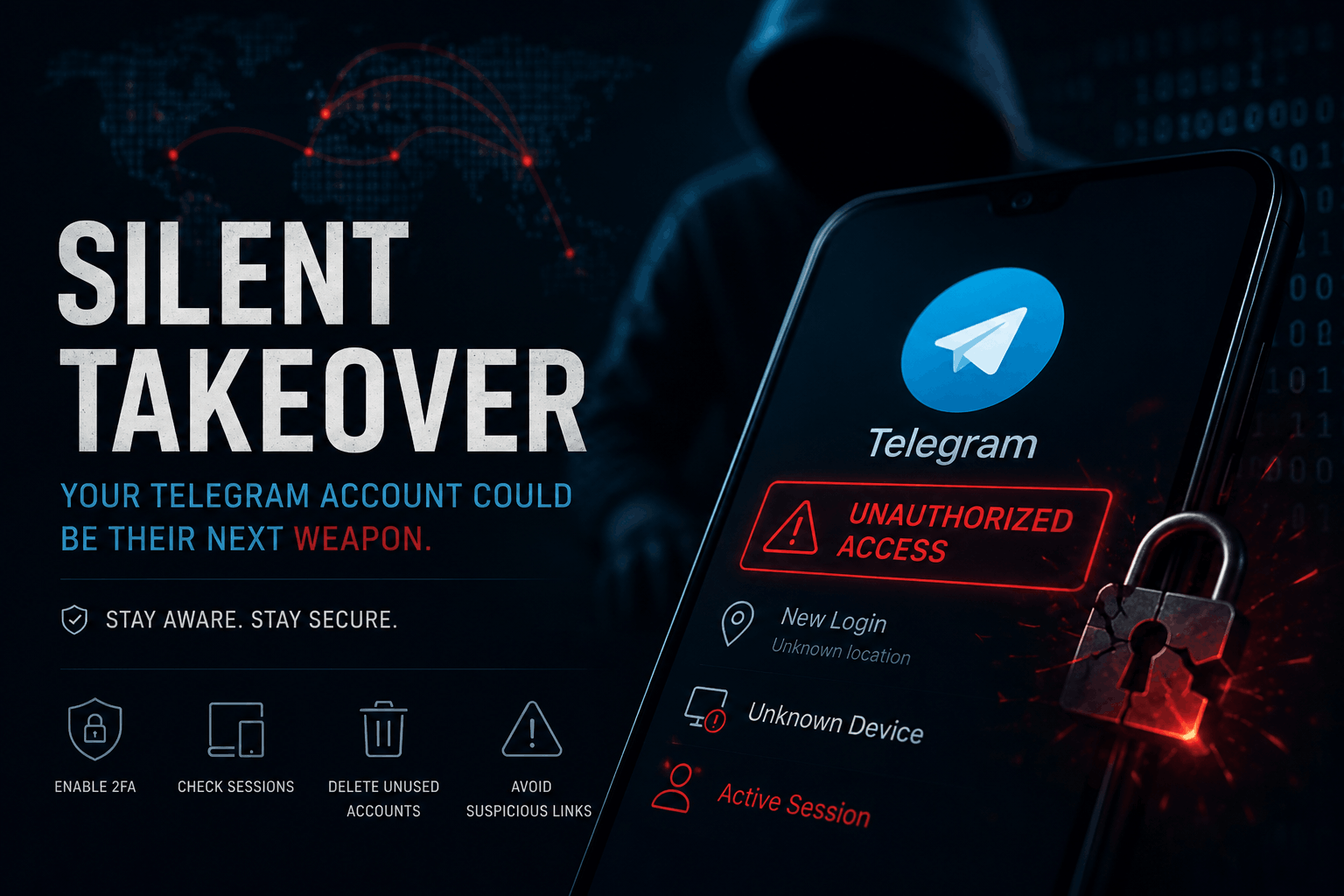
For the last few days, I was helping one of my friends recover his Telegram account after suspicious activity started happening from his profile.
At first, we thought it was just spam.
Then things started getting strange.
Unknown messages were being sent to contacts.
Adult links were getting forwarded automatically.
New sessions kept appearing.
Recovery settings were changed.
Devices were getting linked again even after removal.
And slowly, after monitoring the account activity and conversations, I realized this was much bigger than a simple hacked account.
There is an entire underground ecosystem operating through compromised Telegram accounts.
Not small scams.
Real operations.
banking deals.
Corporate account discussions.
Spam distribution.
Trust-based fraud.
Large financial conversations.
And the most dangerous part is this:
Many victims do not even know their Telegram account is still active somewhere.
The Beginning
The account I observed belonged to one of my friends.
He was not an active Telegram user.
Like many people, he had installed Telegram long ago, used it for some time, and then mostly stopped checking it regularly.
That single habit became the biggest weakness.
One day, suspicious messages started reaching his contacts.
Some people received adult website links.
Others received random promotional messages.
At first, it looked like typical spam.
But when we checked the account properly, things became serious very quickly.
Unknown sessions were active.
Recovery settings appeared modified.
The account had signs of unauthorized access.
And despite removing devices multiple times, new sessions continued appearing again.
That was the moment I decided to carefully observe what was actually happening inside these compromised Telegram ecosystems.
Not to exploit anything.
Not to misuse access.
But to understand how modern cybercriminals are silently using Telegram accounts after compromise.
What I Observed After Accessing the Account
Once I started monitoring the account activity, I noticed something most people would never expect.
The hacked account was not being used for fun.
It was being used like infrastructure.
Inside chats and groups, there were discussions related to:
- corporate bank accounts
- high transaction limit accounts
- mule account operations
- fake financial setups
- payment handling
- spam distribution
- account verification
- mass messaging
- suspicious business conversations
Telegram chat Images shared here: Click here
Some conversations mentioned daily transaction limits in lakhs and crores.
Some users discussed corporate accounts with extremely high transfer capacities.
Other chats included suspicious banking-related details and coordination messages.
There were also multiple accounts sending adult or spam links to contacts automatically.
This explains something important.
Most hacked Telegram accounts are not hacked because someone wants your personal chats.
They are hacked because your identity has value.
Your contacts have value.
Your account age has value.
Your trust has value.
Why Inactive Telegram Users Become Easy Targets
After observing multiple compromised accounts and speaking with friends who faced similar incidents, one pattern became very clear.
Most victims were inactive Telegram users.
Why?
Because inactive users usually:
- never check active sessions
- ignore login notifications
- do not enable two-step verification
- reuse weak passwords
- uninstall the app but never delete the account
- assume “nothing important is there”
This creates the perfect environment for silent persistence.
Many people think deleting the Telegram app removes their account.
It does not.
If the account still exists, attackers can continue using active sessions unless they are manually terminated.
And since inactive users rarely monitor Telegram, attackers can stay hidden for weeks or months.
The “No Notification” Problem
One thing that shocked me during this observation was how silently these compromises continue.
Technically, Telegram usually sends login notifications for new sessions.
But in real-world situations, victims often:
- ignore notifications
- miss them completely
- never open Telegram again
- do not understand session alerts
- fail to react quickly
Some attackers also move very fast after gaining access.
They immediately:
- add recovery methods
- enable passwords
- maintain multiple sessions
- spread spam
- connect to underground groups
By the time the victim notices suspicious activity, the account may already be deeply integrated into spam or fraud operations.
Why Are Porn Links Commonly Sent From Hacked Accounts?
This was one of the first things I noticed.
Compromised accounts were sending adult links to contacts automatically.
At first, it looked random.
But after deeper observation, it started making sense.
These links are often used for:
- traffic generation
- malware delivery
- phishing pages
- fake crypto schemes
- affiliate fraud
- scam funnels
- account warming
Attackers understand human psychology extremely well.
A message from a known contact has higher trust than a random spam message.
That trust becomes the weapon.
Your hacked account becomes the delivery system.
The Underground Economy Behind Telegram Accounts
The most disturbing part of this observation was understanding how valuable Telegram accounts have become inside cybercrime ecosystems.
Aged accounts are trusted more.
Accounts with real contacts look legitimate.
Old accounts bypass suspicion.
Compromised accounts are used to:
- spread scams
- build fake trust
- communicate with targets
- distribute spam
- coordinate operations
- join restricted groups
- avoid platform restrictions
Some operations appear highly organized.
This is no longer “random hacking.”
This is structured cybercrime infrastructure.
Persistence Tactics Observed
One thing I noticed repeatedly was persistence.
Even after removing suspicious sessions, access sometimes returned again.
This suggests attackers often:
- steal sessions
- maintain secondary access
- use linked recovery methods
- exploit weak account recovery setups
- rely on victim inactivity
Many victims recover the account once and assume the problem is solved.
But if every linked session, recovery option, and security setting is not reviewed carefully, attackers may return again later.
The Biggest Mistake Most Users Make
The biggest mistake is assuming Telegram is unimportant.
People secure:
- banking apps
- Gmail
But Telegram is often ignored completely.
That is exactly why attackers love it.
Because Telegram gives them:
- trusted communication
- identity reuse
- spam infrastructure
- social engineering opportunities
- access to existing contact networks
Modern cybercrime is not only about stealing passwords anymore.
It is about stealing trust.
How To Protect Your Telegram Account
If you actively use Telegram, securing your account takes less than five minutes.
Go to:
Profile → Privacy and Security → Two-Step Verification
Enable it immediately.
Set a strong password.
This adds an extra protection layer even if someone somehow gets your OTP.
Also:
- regularly review active sessions
- remove unknown devices
- avoid unofficial Telegram apps
- never share OTPs
- avoid suspicious APK files
- secure your SIM card
- monitor linked email addresses
- use a unique password
And if you do not use Telegram anymore, consider deleting the account completely instead of simply uninstalling the app.
Unused accounts are becoming easy targets.
Final Thoughts
This observation completely changed the way I look at Telegram security.
What started as helping a friend recover his account slowly exposed a much larger underground ecosystem operating silently behind compromised profiles.
Most victims never realize what their account becomes after compromise.
A spam source.
A scam tool.
A fake identity.
A trusted delivery channel.
And sometimes, part of much larger financial fraud operations.
Cybersecurity is no longer only about protecting devices.
It is about protecting identity, trust, and digital presence.
Because in modern cybercrime, even an inactive Telegram account has value.
Ethical Note
This article was written for cybersecurity awareness and educational purposes only.
The observations mentioned were limited to recovery assistance and security analysis involving a compromised account belonging to a friend.
No exploitation, misuse, or unauthorized activity was performed.
Sensitive information has been removed or redacted to protect privacy and prevent misuse.